• Skip to content
  • Skip to primary sidebar
  • Skip to footer

Header Right

  • Home
  • About
  • Contact

Tax-Saving Tips COVID-19

529 withdrawals and more tax-saving tips

October 15, 2021 by John Sanchez

Taxation of 529 College Savings Account Withdrawals

529 withdrawals

The big advantage of 529 plans is that qualified withdrawals are always federal-income-tax-free—and usually state-income-tax-free too.

What you may not know is that not all 529 withdrawals are tax-free qualified withdrawals, even in years when you have heavy college costs.

Here are six important points to know about 529 withdrawals.

Point No. 1: You Usually Have Several Payment Options

Say you are the 529 account owner or plan participant. Plans commonly use both terms to describe the person who established and controls the account. This letter will use account owner.

As the account owner, you can generally have a withdrawal check cut in your own name or have an electronic deposit made into your own account.

Alternatively, you can have a withdrawal issued in the name of the account beneficiary (the college student for whom you set up the 529 account, usually a child or grandchild) or issued directly to the educational institution for the benefit of the account beneficiary.

You choose your payment option by submitting a withdrawal request to the 529 plan.

Point No. 2: Watch Out for Withdrawals from 529 Accounts Funded with Custodial Account Money

Say you funded the 529 account with money that came from a custodial account that was set up for the account beneficiary—your child or grandchild—under your state’s Uniform Gift to Minors Act (UGMA) or Uniform Transfer to Minors Act (UTMA).

In this situation, you must use any money taken from the custodial account for the benefit of the child or grandchild.

You can’t take a 529 account withdrawal for yourself if the 529 account was funded with money from a child’s or grandchild’s custodial account. Because the money in the 529 account came from the custodial account, the 529 account money legally belongs to your child or grandchild, not you.

On the other hand, if you funded the 529 account with your own money, the money in the account is fair game. You can take withdrawals and do whatever you want with them—subject to the potential federal income tax implications explained later.

Point No. 3: The IRS Knows about Withdrawals

For any year that a 529 withdrawal is taken, the plan must issue a Form 1099-Q, Payments From Qualified Education Programs (Under Sections 529 and 530), by February 1 of the following year.

If the withdrawal goes to the 529 account beneficiary (your child or grandchild), the 1099-Q goes to him or her. If the withdrawal goes to you as the account owner, the 1099-Q goes to you.

Either way, the IRS gets a copy, so the IRS knows what happened.

Point No. 4: Withdrawals May Be Taxable Even in Years When Substantial College Costs Are Incurred

When the Form 1099-Q shows withdrawn earnings, the IRS becomes interested in the 1099-Q recipient’s Form 1040 because some or all of the earnings might be taxable. Here’s the deal on that.

Withdrawn earnings are always federal-income-tax-free and penalty-free when total withdrawals for the year do not exceed what the IRS calls the account beneficiary’s adjusted qualified education expenses, or AQEE, for the year.

AQEE equals the sum of the 529 account beneficiary’s

  • college tuition and related fees;
  • room and board (but only if the beneficiary carries at least half of a full-time course load);
  • required books, supplies, and equipment;
  • computer hardware and peripherals, software, and internet access costs; and
  • expenses for special needs services.

Next, you must subtract any federal-income-tax-free educational assistance to calculate the account beneficiary’s AQEE.

According to the IRS, tax-free educational assistance includes costs covered by

  • tax-free Pell grants;
  • tax-free scholarships, fellowships, and tuition discounts;
  • tax-free veterans’ educational assistance;
  • an employer’s tax-free educational assistance program under Internal Revenue Code Section 127; and
  • any other tax-free educational assistance (other than assistance received in the form of a gift or an inheritance).

In addition, tax-free educational assistance includes any costs used to claim the American Opportunity tax credit or the Lifetime Learning tax credit.

Key point. You can also include in AQEE

  • up to $10,000 annually for the account beneficiary’s K-12 tuition costs;
  • the account beneficiary’s fees, books, supplies, and equipment required to participate in a registered apprenticeship program; and
  • interest and principal payments on qualified student loan debt owed by the account beneficiary or a sibling of the account beneficiary—subject to a $10,000 lifetime limit.

Bottom line. When withdrawals during the year exceed AQEE for the year, all or part of the withdrawn earnings will be taxable. When withdrawals don’t exceed AQEE, all the withdrawn earnings are federal-income-tax-free.

Point No. 5: When You Keep a Withdrawal, There Are Tax Consequences

Assuming the 529 account was funded with your own money (as opposed to money from a custodial account), you are free to change the 529 account beneficiary to yourself and then take federal-income-tax-free withdrawals to cover your own AQEE if you decide to go back to school.

But if you take a withdrawal that you use for purposes other than education, report the taxable portion of any related account earnings as miscellaneous income on your Form 1040. Taxable amounts may also get hit with a 10 percent penalty tax to boot (see below).

Finally, if you liquidate a loser 529 account (worth less than the total amount of contributions), there are no federal income tax consequences. (The government stopped participating in your losses for tax years 2018-2025.)

Point No. 6: Withdrawals Not Used for Education Can Also Be Hit with a 10 Percent Penalty Tax

As explained earlier, some or all of the earnings included in a 529 withdrawal taken during the year must be included in gross income when the withdrawn earnings exceed the account beneficiary’s AQEE for the year. But there’s more.

According to the general rule, the taxable amount of earnings is also hit with a 10 percent penalty tax.

But the 10 percent penalty tax doesn’t apply to earnings that are taxable only because the account beneficiary’s AQEE was reduced by

  • tax-free Pell grants;
  • tax-free scholarships, fellowships, and tuition discounts;
  • tax-free veterans’ educational assistance;
  • tax-free employer-provided educational assistance;
  • any other tax-free educational assistance; or
  • costs used to claim the American Opportunity or Lifetime Learning tax credit.

In addition, the 10 percent penalty tax doesn’t apply to earnings withdrawn when the account beneficiary attends one of the U.S. military academies (such as West Point, Annapolis, or the Air Force Academy).

Finally, the 10 percent penalty tax doesn’t apply to earnings withdrawn after the account beneficiary dies or becomes disabled.

Tax-Home Rules You Should Know

When you travel out of town overnight, you need to know the tax-home rule. The IRS defines your tax home, and it’s not necessarily in the same town where you have your personal residence.

If you have more than one business location, one of the locations will be your tax home. It’s generally your main place of business.

In determining your main place of business, the IRS takes into account three factors:

  1. the length of time you spend at each location for business purposes;
  2. the degree of business activity in each area; and
  3. the relative financial return from each area.

Here’s a recent court case that illustrates this rule.

Akeem Soboyede, an immigration attorney, was licensed to practice law in both Minnesota and Washington, D.C., and he maintained solo law practices in both Minneapolis and Washington, D.C.

Although Mr. Soboyede’s primary personal residence was in Minneapolis, he divided his time between his office in Minneapolis and his office in Washington, D.C.

Get ready for a chuckle: in court, Mr. Soboyede admitted in his testimony that he did not keep the necessary documentation because he “did not know . . . [he] was going to get audited.”

Due to the lack of records, the IRS disallowed most of the deductions. The remaining issue for the court was the travel expenses for lodging, for which Mr. Soboyede had the records.

The court noted that Mr. Soboyede’s lodging expenses were only deductible if he was “away from home” as required by Section 162(a)(2).

In deciding whether Mr. Soboyede’s tax home was in Minneapolis or Washington, D.C., the court used the following two factors:

  • Where did he spend more of his time?
  • Where did he derive a greater proportion of his income?

Answer: Washington, D.C. Think about this: He had his home in Minneapolis, but the court ruled that his “tax home” was in Washington, D.C. As a result, he lost his travel deductions.

Principal Residence Gain Exclusion Break

Here’s a look at how to apply the $250,000 ($500,000, if married) principal residence tax break when getting married or divorced, or when converting another property into your home.

In both marriage and divorce situations, a home sale often occurs. Of course, the principal residence gain exclusion break can come in very handy when an appreciated home is put on the block.

Sale during Marriage

Say a couple gets married. They each own separate residences from their single days. After the marriage, the pair files jointly. In this scenario, it is possible for each spouse to individually pass the ownership and use tests for their respective residences. Each spouse can then take advantage of a separate $250,000 exclusion.

Sale before Divorce

Say a soon-to-be-divorced couple sells their principal residence. Assume they still are legally married as of the end of the year of sale because their divorce is not yet final. In this scenario, the divorcing couple can shelter up to $500,000 of home sale profit in two different ways:

  1. Joint return. The couple could file a joint Form 1040 for the year of sale. Assuming they meet the timing requirements, they can claim the $500,000 joint-filer exclusion.
  2. Separate returns. Alternatively, the couple could file separate returns for the year of sale, using married-filing-separately status. Assuming the home is owned jointly or as community property, each spouse can then exclude up to $250,000 of his or her share of the gain.

To qualify for two separate $250,000 exclusions, each spouse must have

  • owned his or her part of the property for at least two years during the five-year period ending on the sale date, and
  • used the home as his or her principal residence for at least two years during that five-year period.

Sale in Year of Divorce or Later

When a couple is divorced as of the end of the year in which their principal residence is sold, they are considered divorced for that entire year. Therefore, they will be unable to file jointly for the year of sale. The same is true, of course, when the sale occurs after the year of divorce.

Key point. Under the preceding rules, both ex-spouses will typically qualify for separate $250,000 gain exclusions when the home is sold soon after the divorce. But when the property remains unsold for some time, the ex-spouse who no longer resides there will eventually fail the two-out-of-five-years use test and become ineligible for the gain exclusion privilege.

Let’s see how we can avoid that unpleasant outcome.

When the Non-Resident Ex Continues to Own the Home for Years after Divorce

Sometimes ex-spouses will continue to co-own the former marital abode for a lengthy period after the divorce. Of course, only one ex-spouse will continue to live in the home. After three years of being out of the house, the non-resident ex will fail the two-out-of-five-years use test. That means when the home is finally sold, the non-resident ex’s share of the gain will be fully taxable.

But with some advance planning, you can prevent this undesirable outcome.

If you will be the non-resident ex, your divorce papers should stipulate that as a condition of the divorce agreement,

  • your ex-spouse is allowed to continue to occupy the home for as long as he or she wants, or
  • until the kids reach a certain age, or
  • for a specified number of years, or
  • for whatever time period you and your soon-to-be ex can agree on.

At that point, either the home can be put up for sale, with the proceeds split per the divorce agreement, or one ex can buy out the other’s share for current fair market value.

This arrangement allows you, as the non-resident ex, to receive “credit” for your ex’s continued use of the property as a principal residence. So, when the home is finally sold, you should pass the two-out-of-five-years use test and thereby qualify for the $250,000 gain exclusion privilege.

The same strategy works when you wind up with complete ownership of the home after the divorce, but your ex continues to live there. Stipulating as a condition of the divorce that your ex is allowed to continue to live in the home ensures that you, as the non-resident ex, will qualify for the $250,000 gain exclusion when the home is eventually sold.

Little-Known Non-Excludable Gain Rule Can Mean Unexpectedly Higher Taxes on a Property Converted into Your Principal Residence

Once upon a time, you could convert a rental property or vacation home into your principal residence, occupy it for at least two years, sell it, and take full advantage of the home sale gain exclusion privilege of $250,000 for unmarried individuals or $500,000 for married, joint-filing couples. Those were the good old days!

Unfortunately, legislation enacted back in 2008 included an unfavorable provision for personal residence sales that occur after that year. The provision can make a portion of your gain from selling an affected residence ineligible for the gain exclusion privilege.

Let’s call the amount of gain that is made ineligible the non-excludable gain. The non-excludable gain amount is calculated as follows.

Step 1. Take the total gain, and subtract any gain from depreciation deductions claimed against the property for periods after May 6, 1997. Include the gain from depreciation (so-called unrecaptured Section 1250 gain) in your taxable income. Carry the remaining gain to Step 3.

Step 2. Calculate the non-excludable gain fraction.

The numerator of the fraction is the amount of time after 2008 during which the property is not used as your principal residence. These times are called periods of non-qualified use.

But periods of non-qualified use don’t include temporary absences that aggregate two years or less due to changes of employment, health conditions, or other circumstances specified in IRS guidance.

Periods of non-qualified use also don’t include times when the property is not used as your principal residence, if those times are

  • after the last day of use as your principal residence, and
  • within the five-year period ending on the sale date.

The denominator of the fraction is your total ownership period for the property.

Step 3. Calculate the non-excludable gain by multiplying the gain from Step 1 by the non-excludable gain fraction from Step 2.

Step 4. Report on Schedule D of Form 1040 the non-excludable gain calculated in Step 3. Also report any Step 1 unrecaptured Section 1250 gain from depreciation for periods after May 6, 1997. The remaining gain is eligible for the gain exclusion privilege, assuming you meet the timing requirements.

The Basics of Depreciation

Are you thinking about buying personal property (such as a car, a computer, or other equipment) or real property (such as a building)? If you use the property for personal purposes, it’s not deductible.

But if you use it in a business, you can deduct the full cost using regular depreciation, bonus depreciation, or IRC Section 179 expensing.

Regular depreciation takes three to 39 years depending on the property involved, while bonus depreciation allows you to deduct 100 percent of the cost of personal property in one year through 2022. Up to $1,050,000 of personal property may also be deducted in one year under IRC Section 179.

But depreciation won’t begin if you purchase property with the intent of beginning a new business. You must actually be in business to claim depreciation. This doesn’t require that you make sales or earn profits—only that your business is a going concern.

Also, depreciation doesn’t begin the moment you purchase property for your business. It begins only when you place property in service in your business. You don’t have to use the property to place it in service, but the property must be available for use in your active business. This could occur after you purchase the property.

Finally, if you use regular depreciation, you must apply rules called conventions to determine the month in which your depreciation deduction begins. The earlier in the year, the larger your deduction for the first year.

The default rule is that regular depreciation for personal property begins July 1 the first year (mid-year convention). But if you purchase 40 percent or more of your total personal property for the year during the fourth quarter, your depreciation begins at the midpoint of the quarter in which it is placed in service (mid-quarter convention).

First-year depreciation for real property begins at the middle of the month during which the property is placed in service (mid-month convention).

If you have questions, don’t hesitate to contact me.


Filed Under: Tax Saving Tips Covid_19, Tax update, Tax-savings Tagged With: 529 withdrawals, tax, Tax-saving, Tax-saving tips, Tax-Saving Tips COVID-19

New Forgiveness Rules for Past, Current, and New PPP Money

January 13, 2021 by John Sanchez


New Forgiveness Rules for PPP MoneyGood news: the new Paycheck Protection Program (PPP) law enacted with the stimulus package adds dollars to your pocket if you have or had PPP money.


Note that the PPP money comes to you in what appears to be a loan. We say “appears” because you typically pay back a loan.

Done right, however, the PPP loan is 100 percent forgiven. The word “loan” makes some businesses leery of this arrangement. Don’t be. The PPP monetary arrangement is a true “have your cake and eat it too” deal.

And this remarkable deal applies to your past PPP loan, the PPP loan you have outstanding, and the PPP loan you are about to get if you have not had one before. Here are the details:

Loan Proceeds Are Not Taxable

The COVID-19-related Tax Relief Act of 2020 reiterates that your PPP loan forgiveness amount is not taxable income to you.

Expenses Paid with Forgiven Loan Money Are Tax-Deductible

As you may remember, the IRS took the position that expenses paid with PPP loan forgiveness monies were not deductible.

Lawmakers disagreed but were unable to get the IRS to change its position. The IRS essentially told lawmakers, “If you want the expenses paid with a PPP loan to be deductible, change the law.”

And that’s precisely what lawmakers did. The COVID-19-related Tax Relief Act of 2020 states that “no deduction shall be denied, no tax attribute shall be reduced, and no basis increase shall be denied, by reason of the exclusion from gross income.”

In plain English, the expenses paid with monies from a forgiven PPP loan are now tax-deductible, and this change goes back to March 27, 2020, the date the Coronavirus Aid, Relief, and Economic Security (CARES) Act was enacted.

Round 2: Additional Tax-Free PPP Money for You?

If you received an initial PPP loan, you can qualify for a second round (called a “second draw”) of tax-free PPP money.

To qualify for the second-draw PPP money, you must

  1. have 300 or fewer employees;
  2. have suffered a 25 percent or greater loss in revenue during at least one quarter of 2020 when compared to 2019; and
  3. have already used your original PPP money (or be planning to use it soon).

The mechanics of the second-draw PPP loan amount follow the rules that apply to the original (first-draw) PPP loan, with some modifications. The overall limits work as follows:

  • The loans are capped at $2 million or less.
  • If you are not a hotel or restaurant (NAICS code 72), you identify your average monthly payroll for either 2019 or the trailing 12 months and then multiply it by 2.5 to find your loan amount.
  • If you are a hotel or restaurant, you multiply by 3.5.

During a period of your choice, beginning eight weeks from the origination date of the loan and ending 24 weeks after the origination date, you must use 60 percent or more of the monies for defined payroll in order to achieve 100 percent forgiveness.

Expenses that can qualify for forgiveness include the following:

  • Payroll
  • Rent
  • Interest on mortgage obligations
  • Utilities
  • Operations expenditures
  • Property damage
  • Supplier costs
  • Worker protection

And finally, keep these three thoughts in mind:

  1. Act fast, because this money goes in a hurry.
  2. The incoming PPP loan monies are tax-free.
  3. Expenses paid with PPP loan monies that are forgiven are tax-deductible.

New Chance for PPP Monies

Did you miss out on your prior opportunities to receive tax-free PPP cash?

Many did miss out. Why? One reason: the word “loan.” Who wants a loan? No one. Well, almost no one.

But who wants a tax-free cash gift? If you do, read on for the details. But first, you should know that the big picture works like this:

  1. You obtain your tax-free PPP monies from a lender (it’s called a “loan,” but watch that word disappear as you read on).
  2. You spend all the PPP money on yourself if you are self-employed or operate as a partnership; on payroll (including pay to you, if that applies); and on other covered expenses such as rent, interest, utilities, operations, property damage, suppliers, and worker protection.
  3. You apply for loan forgiveness and achieve 100 percent loan forgiveness, which is easy when you spend 60 percent or more of the money on payroll (and yourself if you are self-employed or a partner in a partnership).
  4. You deduct the expenses that you paid with the PPP loan monies that were forgiven.

New Money on the Table

The new COVID-19 stimulus act sets aside $35 billion for first-time PPP applicants, with $15 billion of that made in loans for first-time applicants with 10 or fewer employees or made in amounts less than $250,000 to businesses in low-income areas.

New Deadline

The new deadline of March 31, 2021, replaces the expired deadline of August 8, 2020.

The monies available in this new round of PPP funding are on a first-come, first-served basis. Don’t procrastinate. Get your application for your first-time PPP monies in now.

New Stimulus Law Grants Eight Tax Breaks for Individual Filers

As you know, Congress recently passed a massive new stimulus bill that was enacted into law on December 27, 2020. Most of the public’s attention has been focused on the bill’s authorization of additional stimulus checks, new PPP loans, and other aid targeted to struggling businesses.

But Form 1040 American taxpayers who are not in business are struggling as well. The stimulus bill contains a hodgepodge of eight new or extended tax breaks intended to help Form 1040 filers.

None of these tax breaks are earthshaking by themselves, but together they add up to a nice tax present for COVID-19-weary Americans.

Here are the eight new tax breaks that can help you:

  1. Deduct cash contributions to charity if you don’t itemize.
  2. Deduct up to 100 percent of your adjusted gross income (AGI) as a charitable deduction.
  3. Lengthen to one year the time you have to repay your 2020 employee Social Security taxes if your employer deferred them.
  4. Deduct medical expenses in 2021 using the now-extended 7.5 percent of AGI floor for these deductions.
  5. Carry over unused flexible savings account (FSA) funds to next year.
  6. Use your 2019 income to qualify for the earned income tax credit and/or the child tax credit if you’re a lower-income taxpayer.
  7. Deduct out-of-pocket expenses for personal protective equipment (PPE) if you’re a teacher.
  8. Take advantage of the lifetime learning credit in 2021 if you’re a higher-income taxpayer.

Proof for the Home-Office Deduction

Question. If you have an office outside your personal home—say, downtown—can you have a tax-deductible office inside your home for the same trade or business?

Answer. Yes.

Q. Who says that?

A. The IRS.

Q. Show me where they say that!

In IRS Publication 587, the IRS says this:

Your home office will qualify as your principal place of business if you meet the following requirements:

  1. You use it exclusively and regularly for administrative or management activities of your trade or business.
  2. You have no other fixed location where you conduct substantial administrative or management activities of your trade or business.

The quote above mirrors the law and the legislative history. Note the following points:

  • The administrative office is a “principal” office.
  • You must use this office exclusively for business.
  • You must use this office regularly for business.
  • You must do your administrative work in your home office.
  • You must not do your administrative work in the office outside the home.

Here is a second important quote from IRS Publication 587:

You can have more than one business location, including your home, for a single trade or business.

The IRS makes this rule very clear and straightforward: you may have more than one office for your business, including an office in your home.

ABLE Accounts: A Great Deal for the Disabled and Their Families

Sixty-one million adults and over 12.6 million children in the United States have some type of disability.

If you have a disabled or blind child or other family member, or are disabled or blind yourself, you should know about ABLE (Achieving a Better Life Experience Act) accounts. These tax-advantaged accounts can be a real game changer for the disabled.

Ordinarily, a disabled person who receives government benefits can have only $2,000 in cash or other countable assets. This can make it impossible for disabled people to save money for emergencies, buy a house or car, or take a vacation.

This is where ABLE accounts come in. Contributions to ABLE accounts up to certain levels are not counted for purposes of means-tested programs for the blind and disabled. Disabled people can have up to $100,000 in an ABLE account without losing Social Security disability benefits.

Contributions to ABLE accounts are not deductible for federal income tax purposes, but the money in the account grows tax-free. Withdrawals are also tax-free if made for a variety of living- and disability-related expenses.

Up to $15,000 in total can be contributed to an ABLE account each year. Contributions can come from the disabled beneficiary, from family, and from friends. Disabled people who work can put in an additional amount limited to the lesser of their compensation or $12,490 in 2021.

A total amount of $300,000 to $500,000 can be deposited into an ABLE account, depending on the state. There is only one real drawback to ABLE accounts: they are available only for people who became blind or disabled before reaching age 26. This eliminates the majority of the disabled.

ABLE accounts are run by the states. Forty-two states and the District of Columbia have them. You don’t have to set up an account in the state where you live, and it can pay to shop around.

By the way, if you have a special needs trust, you can keep it. An ABLE account can be set up in addition to a special needs trust.

If you have more questions, feel free to contact us.

Filed Under: Tax Saving Tips Covid_19, Tax-savings Tagged With: PPP Money, Tax Cuts, Tax-Saving Tips COVID-19, tax-savings

Tax-Saving Tips

December 15, 2020 by John Sanchez

December 2020

Husband and wife working together with laptop, tax savings

Good News If Your PPP Loan Is for $50,000 or Less

As you likely know by now, the Paycheck Protection Program (PPP) loan and its forgiveness process have been an ever-changing (and often confusing) ride so far.

With the new rules for PPP loans of $50,000 or less, you escape the most difficult part of the loan forgiveness if you had to consider employees. And you may even obtain more loan forgiveness than you would have otherwise.

Before

Before the $50,000-or-less rule, you had to either suffer a reduction in loan forgiveness or meet one of the many exceptions that allowed you to

  • cut annual salaries or hourly wages by more than 25 percent, and/or
  • reduce the average number of employees or average hours paid.

After

Now, with a PPP loan of $50,000 or less, you don’t have to consider the myriad rules about employees. Regardless of what you did with your employees, you qualify for full forgiveness if

  • your PPP loan is for $50,000 or less,
  • you spent the PPP money on costs that are eligible for forgiveness, and
  • at least 60 percent of the forgiveness is for qualified payroll costs (including defined payroll for owners).

Example. You obtain a PPP loan of $34,000 based on your 2019 Schedule C income and pay to your part-time employee. When COVID-19 hit, you laid off your part-time worker and have not rehired him. Using SBA Form 3508S and the 24-week covered period, you qualify for 100 percent forgiveness of your $34,000 loan because you spent $20,833 (61 percent) on the deemed payroll to yourself and the remainder on five months’ rent and utilities.

Planning note. You are not an employee of your Schedule C business. You receive no W-2 income. But the PPP rules deem your 2019 Schedule C profits as your payroll for PPP loan purposes. The rules cap the Schedule C taxpayer’s loan amount and forgiveness at a maximum of $20,833 when Schedule C income is $100,000 or more.

Four Things to Know When Hiring Your Spouse

Husband and wife working together with laptop, tax savingsIf you own your own business and operate as a proprietorship or partnership (wherein your spouse is not a partner), one of the smartest tax moves you can make is hiring your spouse to work as your employee.

But the tax savings may be a mirage if you don’t pay your spouse the right way. And the arrangement is subject to attack by the IRS if your spouse is not a bona fide employee.

Here are four things you should know before you hire your spouse that will maximize your savings and minimize the audit risk.

  1. Pay benefits, not wages. The way to save on taxes is to pay your spouse with tax-free employee benefits, not taxable wages. Benefits such as health insurance are fully deductible by you as a business expense, but not taxable income for your spouse.

Also, if you pay a spouse only with tax-free fringe benefits, you need not pay payroll taxes, file employment tax returns, or file a W-2 for your spouse.

  1. Establish a medical reimbursement arrangement. The most valuable fringe benefit you can provide your spouse-employee is reimbursement for health insurance and uninsured medical expenses. You can accomplish this through a 105-HRA plan if your spouse is your sole employee, or an Individual Coverage Health Reimbursement Account (ICHRA) if you have multiple employees.
  2. Provide benefits in addition to health coverage. There are many other tax-free fringe benefits you can provide your spouse in addition to health insurance, including education related to your business, up to $50,000 of life insurance, and de minimis fringes such as gifts.
  1. Treat your spouse as a bona fide employee. For your arrangement to withstand IRS scrutiny, you must be able to prove that your spouse is your bona fide employee. You’ll have no problem if:
  • you are the sole owner of your business,
  • your spouse does real work under your direction and control and keeps a timesheet,
  • you regularly pay your spouse’s medical and other reimbursable expenses from your separate business checking account, and
  • your spouse’s compensation is reasonable for the work performed.

New IRS Efforts to Destroy Tax Deductions for PPP Paid Expenses

From what we know, when lawmakers originally passed the PPP they thought that under its provisions,

  • you did not pay taxes on the forgiveness amount, and
  • you also could deduct the expenses that you paid with the PPP money.

Obstacle

In late April, the IRS issued Notice 2020-32, which asserts that PPP loan recipients may not deduct business expenses paid using the PPP monies that gave rise to forgiveness (defined payroll, rent, utilities, and interest).

Lawmakers’ Take

In a letter to Secretary of the Treasury Steven Mnuchin on May 5, 2020, Senator Chuck Grassley (chairman of the Committee on Finance), Senator Ron Wyden (ranking member on the Committee on Finance), and Congressman Richard E. Neal (chairman of the Committee on Ways and Means) jointly stated that the IRS got this wrong and that the intent of the CARES Act was for the PPP to be a tax-free grant.

The Do-Nothings

The IRS was unmoved by the lawmakers’ letter. The IRS position was clear: no deduction for the expenses paid with the PPP money. The IRS understood that perhaps lawmakers didn’t mean that to happen, but in the eyes of the IRS, the way that the lawmakers enacted the law created the problem. To fix it, lawmakers simply need to pass a new law.

Frankly, we thought that lawmakers would pass a new law and take care of this problem. But no, that has not happened.

New Nails in the Coffin

On November 18, 2020, the IRS drove two new nails into the coffin regarding deductions for PPP monies that were forgiven and spent on payroll, rent, interest, or utilities.

  • Nail 1. In Revenue Ruling 2020-27, the IRS ruled that you may not deduct expenses paid with the PPP loan monies if you have received or expect to receive forgiveness of those loan monies.
  • Nail 2. In Revenue Procedure 2020-51, the IRS set forth safe-harbor procedures to follow if your PPP forgiveness is subsequently denied or if you decide not to apply for forgiveness.

With the rulings described above, the IRS has clarified its position to lawmakers: if you don’t like the non-deductibility of expenses paid with PPP monies, change the law.

What to Do Now

Join with hundreds of thousands of business taxpayers and tax professionals who are urging lawmakers to fix the non-deductibility issue.

To help encourage the action you desire (whether you’re for or against deductibility), get in touch with the lawmakers.

  • 3612 is the Senate bill to make the PPP forgiveness money used to pay business expenses tax-deductible. To express your yea or nay on S. 3612, contact your senators. You can find them at this link: https://www.senate.gov/senators/contact.
  • R. 6821 is the House bill to make the PPP forgiveness money used to pay business expenses tax-deductible. To express your yea or nay on H.R. 6821, contact your representative. You can find him or her at this link: https://www.house.gov/representatives.

Your yea or nay doesn’t need to be long or formal. You can fax, email, or phone and simply say you support or oppose the bill. It’s that easy—and it’s effective. Do it.

The IRS Goes Easy on Taxpayers Who Owe Back Taxes

Are you one of the over 11 million Americans who owe the IRS back taxes? The IRS temporarily suspended most collection efforts during the first wave of the coronavirus pandemic through its “People First Initiative.” This initiative expired July 15, 2020.

The IRS is now ready to go after delinquent accounts again. However, the agency recognizes that substantial numbers of taxpayers cannot pay what they owe right now. To help them, it has promulgated a new Taxpayer Relief Initiative.

The new Taxpayer Relief Initiative is relatively modest in scope, but it can be a big help if you owe the IRS.

Among other things, the new initiative gives you an extra 60 days to pay off a tax bill. You now have 180 days instead of 120 days to make a lump sum payment of all you owe.

The initiative also makes it easier to obtain, keep, and modify installment agreements with the IRS. These allow you to make monthly payments over several years.

If you owe $50,000 to $250,000, you may even be able to obtain an installment agreement without the IRS filing a tax lien on your property—something that has never been possible before.

The IRS is also stressing that it will help taxpayers who have already entered into installment agreements or offers in compromise with the agency and who are now having trouble making their payments.

You may also be able to get IRS penalties reduced or eliminated.

Whatever you do, don’t ignore a tax bill from the IRS. And never feel you’re helpless when confronted by the IRS collection juggernaut. You always have options, no matter how much you owe.

Tax-Smart College Savings Strategies for Parents

Parents Tax savingsCollege is expensive. Data for the 2019–2020 academic year indicates that the average cost of tuition, fees, room, and board was $30,500. The tax law has provisions to help you cover the costs, including Coverdell accounts, Section 529 savings plans, and Section 529 tuition plans.

Contribute to a Coverdell Education Savings Account

You can contribute up to $2,000 per year to the child’s Coverdell Education Savings Account (CESA). If you have several children, you can set up a CESA for each of them.

Contributions are non-deductible, but earnings are allowed to accumulate free of any federal income tax. You can then take tax-free withdrawals to pay for the account beneficiary’s post-secondary tuition, fees, books, supplies, and room and board.

Maybe not for you. Your right to contribute is phased out between modified adjusted gross income (MAGI) of $95,000 and $110,000 if you are unmarried, or between $190,000 and $220,000 if you are a married joint filer.

Contribute to a Section 529 College Savings Plan

Section 529 college savings plans are state-sponsored arrangements named after the section of our beloved Internal Revenue Code that authorizes very favorable treatment under the federal income and gift tax rules.

You as the parent of a college-bound child begin by making contributions into a trust fund set up by the state plan that you choose. The money goes into an account designated for the beneficiary whom you specify (your college-bound child).

You can then make contributions via a lump-sum pay-in or via installment pay-ins stretching over several years. The plan then invests the money using the investment direction option that you select.

When your child reaches college age, you can take federal-income-tax-free withdrawals to pay eligible college expenses, including room and board under most plans. Plans will generally cover expenses at any accredited college or university in the country (not just schools within the state sponsoring the plan). Community colleges qualify as well.

In essence, a Section 529 college savings plan account is a tax-advantaged way to build up a college fund for your child.

Don’t Confuse Savings Plans with Prepaid Plans

Don’t mix up Section 529 college savings plans with Section 529 prepaid college tuition plans—which we will give only a brief mention here. Both types of plans are properly called “Section 529 plans” because both are authorized by that section of the Internal Revenue Code. Both receive the same favorable federal tax treatment. But that’s where the resemblance ends.

The big distinction is that prepaid tuition plans lock in the cost to attend certain colleges. In other words, the rate of return on a prepaid tuition plan account is promised to match the inflation rate for costs to attend the designated school or schools—nothing more, nothing less. That’s okay if that’s what you really want.

No Kiddie Tax on Section 529 Plan

You don’t have to worry about the kiddie tax if you set up a custodial 529 plan in the child’s name. The 529 plan is an investment plan where the monies remain in the plan. You make contributions with after-tax dollars.

When the child takes the money out of the plan for college, he or she does so tax-free when the funds are used to pay for qualified higher education expenses.

If you have more questions, feel free to contact us.

Filed Under: Business, Tax Saving Tips Covid_19, Tax update Tagged With: Tax-saving tips, Tax-Saving Tips COVID-19

Tax-Saving Tips

October 31, 2020 by John Sanchez

The Latest on Payroll Tax Deferral

The Latest on Payroll Tax Deferral

The Latest on Payroll Tax Deferral

If you have employees, you must withhold their 6.2 percent share of the Social Security tax from their wages up to an annual wage ceiling ($137,700 for 2020). You must pay the money to the IRS along with your matching 6.2 percent employer share of the tax.

But under the Coronavirus Aid, Relief, and Economic Security (CARES) Act, as you likely know, employers are allowed to defer paying their 6.2 percent share of the Social Security tax on wages paid to employees through the end of 2020. Fifty percent of these deferred taxes will have to be paid during 2021 and the remainder in 2022.

Both the Trump administration and the IRS have issued orders permitting employers to defer withholding and paying the employee portion of the Social Security tax for a limited time. But the executive order on employee deferral is much more limited in scope than the CARES Act employer deferral, and it’s beset with practical problems for employers.

Which Taxes Can Be Deferred?

The deferral applies only to the employee portion of the Social Security tax due on wages paid from September 1, 2020, through December 31, 2020. No other payroll taxes can be deferred.

Which Employees Qualify for the Deferral?

Only employees who earn less than $4,000 biweekly qualify for the deferral. Employees who are not paid on a biweekly basis qualify if their pay is equivalent to less than $4,000 biweekly. This would include employees who are paid less than

  • $2,000 weekly,
  • $4,333 semimonthly, or
  • $8,666.67 monthly.

Each pay period is tested separately. An employee who earns too much during one pay period can still qualify for the deferral if he or she earns less than the ceiling amount in a later pay period.

Is the Deferral Mandatory?

IRS officials have stated that the deferral is not mandatory. Employers are not obligated to offer the deferral to their employees. This is so even if an employee requests it.

What Happens When the Deferral Period Ends?

The employee Social Security tax deferral ends on December 31, 2020. IRS guidance provides that the deferred taxes must then be paid “ratably” from wages paid from January 1, 2021, through April 30, 2021. Employers must withhold and pay the deferred taxes from employee wages paid during this period.

Thus, from January 1, 2021, through April 30, 2021, most employees will have to pay a 12.4 percent Social Security tax instead of the normal 6.2 percent. This amounts to a 6.2 percent pay cut for affected employees for four months.

What If Employees Quit or Get Fired?

If an employee quits or is fired during the four-month repayment period, there may not be enough wages paid to cover the deferred Social Security taxes. The IRS says that in this event employers can “make arrangements to otherwise collect” the deferred taxes. What form such “arrangements” could take is unclear.

Interest, penalties, and additions to taxes will begin to accrue on any unpaid deferred Social Security taxes starting May 1, 2021. Thus, if you (the employer) fail to remit the deferred monies because employees were not employed during the collection period, you are on the hook.

Due to the uncertainty involved, many employers have reportedly elected not to participate in the employee Social Security tax deferral.

Using Whole or Partial Rooms for Your Home Office

Home Office With the COVID-19 pandemic still going on, you may be spending more time working from your home office.
You may have taken some extra rooms for your business use. Is that okay?

Section 280A(c) states that you may claim a home office based on the portion of the dwelling that you use exclusively and regularly for business. Thus, the law dictates no specific number of rooms or particulars regarding the size of the office.

The courts make this rule clear, as you can see in the Mills (less than one room) and Hefti (lots of rooms) cases described below.

The Mills Case

Albert Victor Mills maintained an office in his apartment from which he conducted his rental property management business. The apartment was small, totaling only 422 square feet. In the office area of the apartment where Mr. Mills had his desk, he also kept tools, equipment, paint supplies, and a filing cabinet.

The court agreed with Mr. Mills’s allocations and awarded the home-office deduction based on his claimed 23 percent business use of the 422-square-foot apartment.

Planning note. Mr. Mills did not have a single room dedicated to a home office. He had only an area of the apartment where he grouped his office furnishings, equipment, and supplies. If you have a similar situation, make sure your business assets are located in a group.

The Hefti Case

Charles R. Hefti lived in a big house, totaling 9,142 square feet. He claimed that more than 90 percent of his home was used regularly and exclusively for business.

Based on its review of the rooms, the court concluded that 13 rooms, totaling 19 percent of the home, were used exclusively and regularly for business.

Insights

The deductible portion of your home for an office includes the area used exclusively and regularly for business.

Let’s say you have an office in one room and your files in a second room, and you never use these rooms for personal purposes. Further, let’s say you use the office area on a daily basis and the files area in connection with that daily work.

Both rooms would meet the exclusive and regular use requirements, just as Mr. Mills’s and Mr. Hefti’s offices met these rules.

But Not This

“Exclusive use” means that you must use a specific portion of the home only for business purposes. You must make no other use of the space.

Exception. One exception to the exclusive use rule is storage of inventory or product samples if the home is the sole fixed location of a trade or business selling products at retail or wholesale.

Example 1. Your home is the only fixed location of your business, which involves selling mechanics’ tools at retail. You regularly use half of your basement for storage of inventory and product samples. You sometimes use the area for personal purposes. The expenses for the storage space are deductible even though you do not use this part of your basement exclusively for business.

Example 2. In Pearson, Dr. Pearson practiced orthodontics in a downtown medical building but retained the dental records of more than 3,000 patients in 36 file drawers (each measuring 26 inches by 14 inches by 12 inches) and had 1,461 boxes containing orthodontic models (each box measuring 10 inches by 6 inches by 2 1/2 inches).

He stored the records in the attic and basement of his home. The areas used for such storage were not separate rooms, and the remaining portions of the attic and basement were used by Dr. Pearson and his family for personal purposes.

The court ruled that Dr. Pearson may not treat the storage areas as home-office expenses because the records were not inventory or samples and Dr. Pearson did not operate a wholesale or retail trade or business from his home.

Don’t Let the IRS Set Your S Corporation Salary

You likely formed an S corporation to save on self-employment taxes.

If so, is your S corporation salary

  • nonexistent?
  • too low?
  • too high?
  • just right?

Getting the S corporation salary right is important. First, if it’s too low and you get caught by the IRS, you will pay not only income taxes and self-employment taxes on the too-low amount, but also both payroll and income tax penalties that can cost plenty.

Second, in most cases, the IRS is going to expand the audit to cover three years and then add the income and penalties for those three years.

Third, after being found out, you likely are now stuck with this higher salary, defeating your original purpose of saving on self-employment taxes.

Getting to the Number

The IRS did you a big favor when it released its “Reasonable Compensation Job Aid for IRS Valuation Professionals.”

The IRS states that the job aid is not an official IRS position and that it does not represent official authority. That said, the document is a huge help because it gives you some clearly defined valuation rules of the road to follow and takes away some of the gray areas.

Market Approach

The market approach to reasonable compensation compares the S corporation’s business with others and then looks at the compensation being paid by those businesses to employees who look like you, the shareholder-employee who is likely the CEO.

The question to be answered is, how much compensation would be paid for this same position, held by a nonowner in an arm’s-length employment relationship, at a similar company?

In its job aid, the IRS states that the courts favor the market approach, but because of challenges in matching employees at comparable companies, the IRS developed other approaches.

Cost Approach

The cost approach breaks your employee activities into their components, such as management, accounting, finance, marketing, advertising, engineering, purchasing, janitorial, bookkeeping, clerking, etc.

Health Insurance

The S corporation’s payment or reimbursement of health insurance for the shareholder-employee and his or her family goes on the shareholder-employee’s W-2 and counts as compensation, but it’s not subject to payroll taxes, so it fits nicely into the payroll tax savings strategy for the S corporation owner.

Pension

The S corporation’s employer contributions on behalf of the owner-employee to a defined benefit plan, simplified employee pension (SEP) plan, or 401(k) count as compensation but don’t trigger payroll taxes. Such contributions further enable the savings on payroll taxes while adding to the dollar amount that’s considered reasonable compensation.

Planning note. Your S corporation compensation determines the amount that your S corporation can contribute to your SEP or 401(k) retirement plan. The defined benefit plan likely allows the corporation to make a larger contribution on your behalf.

Section 199A Deduction

The S corporation’s net income that is passed through to you, the shareholder, can qualify for the 20 percent Section 199A tax deduction on your Form 1040.

Reasonable Compensation Analysis Service

Contact our office to schedule a time to prepare your S-Corp Reasonable Compensation Analysis before the new year begins.

Getting Around the New Law That Impairs the Stretch IRA Strategy

Last December, the Setting Every Community Up for Retirement Enhancement (SECURE) Act became law.

The SECURE Act was intended mainly to expand opportunities for individuals to increase their retirement savings and to simplify the administration of retirement plans. That’s the good part.

But the act also included a big unfavorable change that kneecapped the so-called stretch IRA estate planning strategy that was employed by well-off IRA owners.

The Stretch IRA Strategy

The stretch IRA strategy involves keeping as much money as possible in your traditional IRA or Roth IRA while you’re still alive and then leaving the account to your spouse or a younger beneficiary, who keeps the inherited account rolling for as long as possible and keeps collecting the tax benefits. Thus, the term “stretch IRA.”

The SECURE Act Imposes a New 10-Year Account Liquidation Rule That Seriously Injures the Stretch IRA Strategy

Unfortunately for the estate plans of well-off IRA owners and the tax situations of some of their IRA beneficiaries, the SECURE Act requires most non-spouse beneficiaries to drain inherited IRAs within 10 years after the account owner’s death.

As we just explained, the pre–SECURE Act required minimum distribution (RMD) rules allowed a non-spouse IRA beneficiary to gradually drain the substantial traditional or Roth IRA inherited from good-ole Grandpa Frank over the beneficiary’s IRS-defined life expectancy. That deal is off the table if Grandpa Frank dies in 2020 or later.

Who Is Affected by the SECURE Act Change?

The SECURE Act’s anti-taxpayer 10-year account liquidation rule doesn’t affect RMDs taken by original traditional IRA owners. They still operate under the same RMD rules as before.

As under pre–SECURE Act law, original owners of Roth IRAs need not take any RMDs for as long as they live. Roth IRA owners are unaffected.

Beneficiaries who want to quickly drain their inherited IRAs also are unaffected.

Bottom line. The 10-year account liquidation rule affects only certain non-spouse beneficiaries who would otherwise keep inherited accounts open for as long as possible to reap the tax advantages.

Exception for Eligible Designated Beneficiaries

The SECURE Act’s 10-year account liquidation rule does not immediately affect accounts inherited by a so-called eligible designated beneficiary.

An eligible designated beneficiary is

  • the surviving spouse of the deceased account owner,
  • a minor child of the deceased account owner,
  • a beneficiary who is no more than 10 years younger than the deceased account owner, or
  • a disabled or chronically ill individual.

Under the exception for eligible designated beneficiaries, RMDs generally can be taken from the inherited account over the life expectancy of the eligible designated beneficiary, beginning with the year following the year of the account owner’s death.

Other non-spouse beneficiaries, whom we will call affected beneficiaries, will be slammed by the 10-year account liquidation rule.

Following the death of an eligible designated beneficiary, the account balance must be distributed within 10 years.

The account balance also must be distributed within 10 years after a child of the account owner reaches the age of majority under local law.

10-Year Account Liquidation Rule Specifics

When applicable, the 10-year account liquidation rule generally applies regardless of whether you, as the original account owner, die before or after your RMD beginning date. Thanks to another SECURE Act change, the RMD rules do not kick in until age 72 if you attain age 70 1/2 after 2019. If you are in that age category, your required beginning date is April 1 of the year following the year during which you attain age 72.

And then, again thanks to the other SECURE Act change, an affected beneficiary must drain the account inherited from you by the end of the 10th calendar year following the year of your demise. Until that deadline is reached, your beneficiary can leave the account untouched.

Failure to comply with the 10-year account liquidation rule will expose the affected beneficiary to a penalty equal to 50 percent of the account balance that remains after the 10-year deadline has passed.

Reminder. As stated earlier, the SECURE Act’s 10-year account liquidation rule applies only to affected beneficiaries who inherit IRAs from original account owners who die after 2019. An IRA inherited by a non-spousal beneficiary from an original account owner who died in 2019 or earlier is unaffected, so the inherited account can still work as a stretch IRA, the same as before the SECURE Act.


Contact us

Filed Under: Business, Tax Saving Tips Covid_19, Tax update Tagged With: Tax Deferral, Tax-saving, Tax-saving tips, Tax-Saving Tips COVID-19

Tax-saving Tips

July 20, 2020 by John Sanchez

ppt loan tax-saving tips during COVID19

Government Clarifies PPP Loan Forgiveness for the Self-Employed

We now have both the new clarity and an easy road to Paycheck Protection Program (PPP) loan forgiveness for the self-employed with no employees.

New Easy Road to 100 Percent Forgiveness

Say thanks to the Paycheck Protection Program Flexibility Act of 2020. This new law creates a 24-week period for you to spend your PPP loan proceeds. If you obtained your loan proceeds before June 5, you can elect to use the eight-week period to spend your PPP loan proceeds.

Here’s the big difference:

  • If the 24-week covered period applies, your loan forgiveness for your deemed payroll is capped at 2.5 months of your 2019 Schedule C net profit, not to exceed $20,833.
  • If you elect the eight-week covered period, your loan forgiveness for your deemed payroll is capped at eight weeks, not to exceed $15,385.

Why Is This Important?

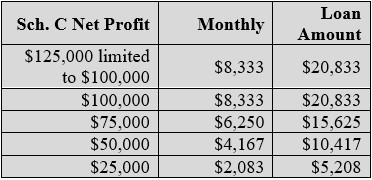
When you file as a Schedule C taxpayer and have no employees, your PPP loan is based on 2.5 times your 2019 Schedule C, line 31, net profit, limited to $20,833.

Here’s how the loan amount works:

Tax_table

You may have your loan proceeds either in hand or in play at this point.

(If you have not yet applied for your PPP loan, do so now. Lawmakers recently reopened the program with an eye on using the remaining funds. Under this new law, the extension of the PPP loan program will last until the earlier of August 8, 2020, or the day the funds are exhausted.)

Let’s keep our eyes on the “easy road” to forgiveness. Under the new 24-month rule, you achieve 100 percent forgiveness when you pay yourself the total loan amount within 10.8 weeks of the date you received your loan proceeds. Let’s round the 10.8 to 11 weeks.

Yes, you are reading this correctly. By simply using the loan proceeds on yourself during the first 11 weeks, you achieve total forgiveness.

Note this. By using the 11 weeks, you achieve total PPP loan forgiveness without having to spend any money on rent, utilities, or interest.

When Can I Apply for Forgiveness?

According to SBA guidance issued on June 22, 2020, you may submit your loan forgiveness application anytime on or before the maturity date of the loan—including before the end of the covered period—if you used all the loan proceeds for which you requested forgiveness.

Example. You receive your $20,833 PPP loan on May 15, 2020. You put the money in your business checking account. During the 11 weeks beginning with May 15, 2020, you write checks to yourself that total $20,833. You can apply for $20,833 of loan forgiveness anytime beginning week 11 or later.

Is It Really This Easy?

Yes.

What About Interest, Rent, and Utilities?

With the 11-week program described above, you don’t have to consider interest, rent, or utilities to achieve 100 percent forgiveness. In fact, why bother? By simply using the 11 weeks, you have less paperwork and worry.

Of course, you might want to consider interest, rent, and utilities if this takes you to earlier forgiveness. To obtain full forgiveness, you could spend as little as 60 percent on payroll and the balance on interest, rent, and utilities.

Example. You file a Schedule C and have no employees, and on June 1, 2020, you obtain a PPP loan of $20,000. During the first eight weeks, you spend $12,000 on yourself and $8,000 on qualified Schedule C deductible business interest, rent, and utilities. You can elect the eight-week period and qualify for 100 percent forgiveness.

Here are the basic PPP forgiveness requirements that apply to your 2020 Schedule C business deduction payments for interest, rent, and utilities:

  • Interest payments on any business mortgage obligation on real or personal property where such obligation was in place before February 15, 2020 (but not any prepayment or payment of principal)
  • Payments on business rent obligations on real or personal property under lease agreements in force before February 15, 2020
  • Business utility payments for the distribution of electricity, gas, water, transportation, telephone, or internet access for which service began before February 15, 2020

Meet the Paid Rule

On page 2 of the 3508EZ instructions, you find this:

Enter any amounts paid to a self-employed individual. For a 24-week Covered Period, this amount is capped at $20,833 (the 2.5-month equivalent of $100,000 per year) for each individual or the 2.5-month equivalent of their applicable compensation in 2019, whichever is lower.

We may suffer from unfounded paranoia because we find the word “paid” a word to be reckoned with. So, in our opinion, you should have your Schedule C business write you checks from its business account. If there’s no separate business account, make sure the business writes checks that pay your personal expenses in the amount of the deemed compensation.

PPP Loan Forgiveness for Partnerships and S and C Corporations

If you operate your business as a partnership or an S or C corporation, you face entity-specific PPP loan forgiveness rules that apply to you as an owner-worker in the business.

The rules that apply to you do not apply to the rank-and-file employee group. The government puts you, the owner-worker, in a separate “owner-employee” category to limit your business’s PPP benefits.

There are four types of owner-employees:

  1. General partners in partnerships
  2. S corporation shareholder-employees
  3. C corporation shareholder-employees
  4. Form 1040, Schedule C filers (e.g., the self-employed, sole proprietors, 1099 recipients, single-member LLCs, and husband and wife LLCs treated as single-member LLCs)

If you own all or part of your business and work in the business, you fall into one of the four categories.

The maximum loan attributable to and forgiveness available for the “compensation paid” to any owner-employee across all businesses is

  • $15,385 for borrowers who received a PPP loan before June 5, 2020, and elected to use an eight-week covered period, or
  • $20,833 for borrowers under the 24-week covered period.

Owners of Multiple Businesses Beware

If you have ownership interests in more than one business, you need to consider that the owner-employee loan maximums apply to all your businesses.

The new interim final rule puts the $15,385 or $20,833 deemed compensation cap on the loan forgiveness for the defined owner-employee, but contains no guidance on how to allocate or otherwise deal with the caps when you have ownership interests in multiple businesses.

Example. You operate an S corporation and a proprietorship. You receive your PPP loan on June 17. The cap on your combined S corporation and proprietorship loan forgiveness attributable to (a) your employment in the S corporation and (b) your profits from the proprietorship is $20,833.

We know you can obtain loan forgiveness for up to $20,833, but we have no guidance on how you would allocate the forgiveness between the S corporation and proprietorship. Perhaps by the time you apply for PPP loan forgiveness, we will have some directions.

Partnerships

The PPP loan forgiveness begins for general partners at the amount of their 2019 net earnings from self-employment (reduced by claimed Section 179 expense deductions, unreimbursed partnership expenses, and depletion from oil and gas properties) multiplied by 0.9235.

You then take the lesser of the amount determined above or $100,000, divide by 12, and multiply by 2.5 to find the loan amount. With this calculation, the maximum loan is $20,833.

The maximum forgiveness attributable due to the partner’s self-employment income is

  • $15,385 if the partnership obtained its loan before June 5, 2020, and elected the eight-week regime, or
  • $20,833 if the partnership is under the 24-week program.

Planning note. Under the 24-week program, the partnership with no employees does not need to spend any amounts on interest, rent, or utilities to obtain full forgiveness. It can obtain full forgiveness in 11 weeks using the calculated self-employment income of up to $20,833 for each partner.

S Corporations

As with any owner-employee, the PPP loan and its forgiveness for “compensation” is capped at $15,385 under the eight-week covered period and $20,833 under the 24-week covered period.

Reminder. The $20,833 cap is based on the maximum defined compensation of $100,000 divided by 12 and then multiplied by 2.5.

Under the 24-week program, the S corporation whose only employee is an owner-employee obtains full loan forgiveness after 11 weeks when using the 24-week covered period without spending anything for interest, rent, or utilities.

If the S corporation with no employees other than the owner-employee elects the eight-week covered period, the corporation has to spend money on interest, rent, and utilities to rise above the compensation cap and create full forgiveness.

The Paycheck Protection Program Flexibility Act of 2020 created a new statutory 60 percent payroll rule that can make it easier to qualify for full forgiveness with payments for interest, rent, and utilities when electing the eight-week covered period.

S corporation owner-employees are capped by the amount of their 2019 employee cash compensation and employer retirement contributions made on their behalf, but employer health insurance contributions made on their behalf cannot be separately added because those payments are already included in their employee cash compensation.

Example. You operate your solo busines as an S corporation. Your 2019 W-2 compensation of $68,000 included $18,000 for medical insurance. Your payroll cost for the PPP loan and its forgiveness includes the full $68,000 plus what the S corporation paid into your retirement plan and to the state for unemployment insurance. The total of these amounts is capped at $100,000, which creates the $20,833 maximum loan amount as explained above.

C Corporations

C corporation owner-employees are capped by the amount of their 2019 employee cash compensation and employer retirement and health insurance contributions made on their behalf.

Example. You operate your business as a C corporation where you are the only employee. In 2019, the corporation paid you a salary of $60,000, contributed $12,000 to your retirement plan, paid $20,000 for your family’s medical insurance, and paid $350 to the state for unemployment insurance.

Your corporation has $92,350 in qualifying payroll costs. Your loan and forgiveness are capped at $19,240 ($92,350 ÷ 12 x 2.5).

Form 1040 Schedule C Businesses

Your PPP loan and its forgiveness for “compensation” are capped at $15,385 under the eight-week covered period or at $20,833 under the 24-week covered period. The cap amounts are computed using your net profit from line 31 of your 2019 Schedule C.

Your easy-peasy road to 100 percent loan forgiveness is the 11-week program. With 11 weeks of taking the loan amount out of the business, you obtain full forgiveness without paying any rent, utilities, or interest.

When Can the Owner-Employee’s Business Apply for Forgiveness?

According to SBA guidance issued on June 22, 2020, you may submit your loan forgiveness application anytime on or before the maturity date of the loan—including before the end of the covered period—if you used all the loan proceeds for which you requested forgiveness.

Example. You receive a $20,833 PPP loan on May 19, 2020. During the 11 weeks beginning with May 19, 2020, your corporation pays qualified payroll costs that total $20,833. You can apply for $20,833 of loan forgiveness anytime beginning with week 11.

COVID-19 Strategy: Hire Family Members to Create Tax Benefits

 Hire Family Members to Create Tax Benefits

The COVID-19 pandemic may create tax benefit opportunities for you and your family members.

For example, you could hire your under-age-18 children, pay them, say, $10,000 each, and they could pay zero federal income taxes. And you or your corporation, the employer, would deduct the $10,000 you paid to each of the children. The child wins. You win. There’s more.

Schedule C Business

Let’s say you operate your business as a sole proprietorship, a single-member LLC that’s treated as a sole proprietorship for tax purposes, a husband-wife partnership, or an LLC that’s treated as a husband-wife partnership for tax purposes.

That means you can hire your under-age-18 child, and the child’s wages will be completely exempt from Social Security and Medicare taxes (FICA tax) and FUTA taxes. To be clear, the FICA tax exemption applies to the employee’s share of FICA tax that’s withheld from the employee’s paychecks and to the employer’s share of FICA tax that your business must pay over to the Feds.

For 2020, your under-age-18 employee-child’s standard deduction will shelter from federal income tax the first $12,400 of wages received if the child has no taxable income from other sources. In other words, no federal income taxes for the child with $12,400 or less in wages.

You can hire the under-age-18 child part-time, full-time, or whatever works for you and the child. Right now, children in this age category are probably not attending school, and the school district’s lengthy summer vacation may have already begun.

In the fall, will your under-age-18 child be attending school in person or online? You probably don’t know anything for sure at this point. But in the COVID-19 era, your under-age-18 child’s availability to work in your business may be at an all-time high.

The wages received by your child can be used to help keep the family afloat financially. If the family is not so financially stressed, your child can use some or all of the wages to fund a college savings account or make a Roth IRA contribution.

What if My Business Is Incorporated?

If you operate your business as an S or a C corporation, your child’s wages received from the business are subject to FICA and FUTA taxes, just like any other employee, regardless of the child’s age.

What if I Hire a Family Member over Age 21?

Do it—if this adds after-tax cash to the family unit! The wages received from your business are subject to FICA and FUTA taxes, just like any other employee. This is the case whether you operate your business as an unincorporated sole proprietorship, a partnership, an LLC, or as an S or a C corporation.

Tax Advantages for Your Business

When you hire a child or other family member, your business deducts the wages paid.

  • If you operate the business as a sole proprietorship, a single-member LLC that’s treated as a sole proprietorship for tax purposes, a husband-wife partnership, an LLC that’s treated as a husband-wife partnership for tax purposes, or an S corporation, the wage expense deduction reduces (a) your individual federal taxable income, (b) your individual net self-employment income, and (c) your individual state taxable income (if applicable).
  • If you operate the business as a C corporation, the corporation deducts the wages paid to a child or other family member. The deductions reduce the corporation’s federal taxable income and probably the corporation’s state taxable income (if applicable).
  • If your business will be unprofitable this year due to the COVID-19 fallout, deductions for wages paid to a child or other family member can create or increase a net operating loss (NOL) for 2020. If so, you can carry back the 2020 NOL for up to five tax years—back to 2015. The NOL carryback can trigger a refund of income taxes paid for the carryback year. That can really help. An NOL carried back to a pre-2018 tax year can be especially helpful because tax rates were generally higher in those da

Keep payroll records just like you would for any other employee to document hours worked and duties performed (e.g., timesheets and job descriptions). Issue W-2s just like you would for any other employee.

IRS Enables Millions to Qualify for the $100,000 IRA Grab and Repay

New IRS guidance expands the possibilities for what is an adverse COVID-19 impact on you for purposes of taking up to $100,000 out of your retirement accounts and repaying it without penalties.

First, let’s look at the rules as they existed before this new IRS guidance. The CARES Act created the first set of favorable rules, and those rules are still in play.

What the CARES Act Says

A coronavirus-related distribution from your qualified retirement plan, Section 403(b) plan, or IRA gets two tax benefits:

  1. If you withdraw and keep the money, you pay no 10 percent early withdrawal penalty and you can spread the income equally over tax years 2020, 2021, and 2022. You also can elect to include it all in tax year 2020, if you want.
  2. You can repay the money within three years of the distribution date and pay no tax or penalty on the amount.

Under the CARES Act relief, you qualify for a coronavirus-related distribution if

  • you, your spouse, or your dependent is diagnosed with COVID-19 with a CDC-approved test;
  • you experience adverse financial consequences as a result of being quarantined, being furloughed or laid off, or having work hours reduced due to COVID-19;
  • you experience adverse financial consequences as a result of being unable to work due to lack of childcare due to COVID-19; or
  • you experience adverse financial consequences as a result of closing or reducing your business hours due to COVID-19.

And then there are two additional CARES Act rules for coronavirus-related distributions:

  1. You can’t treat more than $100,000 per person as a coronavirus-related distribution, and
  2. You must take the distribution on or after January 1, 2020, and before December 31, 2020.

IRS Expands Relief

With the new IRS relief, you now also qualify for coronavirus-related distributions if you experience adverse financial consequences because

  • you, your spouse, or a member of your household has a reduction in pay or self-employment income due to COVID-19;
  • you, your spouse, or a member of your household has a job offer rescinded or a start date for a job delayed due to COVID-19;
  • your spouse or a member of your household is quarantined, is furloughed or laid off, or has work hours reduced due to COVID-19;
  • your spouse or a member of your household is unable to work due to lack of childcare due to COVID-19; or
  • your spouse or a member of your household owns or operates a business that closed or reduced hours due to COVID-19.

Household

For purposes of applying the additional factors, a member of the individual’s household is someone who shares the individual’s principal residence.

Merriam-Webster defines a household as

  • those who dwell under the same roof and compose a family, and
  • a social unit composed of those living together in the same dwelling.

You have to think roommates living together create a household, and if one of them is affected by COVID-19—say, lost his or her job and stopped contributing to the rent—the remaining roommates were adversely affected and should be entitled to the IRA grab-and-repay strategy.

Your Repayment Options

You have many repayment options, as we explain below. To make this easy, let’s say you grab $30,000 from your IRA today and you want to know how you can repay the $30,000 with no taxes or penalties. Here are five scenarios:

Scenario 1. You repay the $30,000 before you timely file your 2020 tax return:

  • You don’t include any of the $30,000 in income on your 2020 tax return. You pay no taxes or penalties.

Scenario 2. You elect to include all $30,000 as income on your timely filed 2020 tax return, but then repay the full $30,000 sometime between filing the 2020 return and July 15, 2023:

  • You amend your 2020 tax return to remove the $30,000 from income and claim a refund of tax paid on that amount.

Scenario 3. You include $10,000 as income on your timely filed 2020 tax return, but then repay the full $30,000 sometime between filing the 2020 return and July 15, 2023:

  • You claim $10,000 of income on your original 2020 tax return, and
  • You later amend your 2020 tax return to remove the $10,000 from income and claim a refund of tax paid on that amount.

Scenario 4. You include $10,000 as income on your timely filed 2020 tax return, but then decide to repay $10,000 of the total $30,000 distribution, which you do on March 1, 2022:

  • You claim $10,000 of income on your 2020 tax return,
  • You claim no income on your 2021 tax return (because you made the $10,000 repayment prior to filing the return), and
  • You claim $10,000 of income on your 2022 tax return.

Scenario 5. You include $10,000 as income on your timely filed 2020 tax return, but then decide to repay $20,000 of the total $30,000 distribution, which you do on November 1, 2021. This one is tricky because you have two ways to do it:

  • You claim no income from the distribution on either your 2021 or 2022 tax return, or
  • You claim $10,000 of income on your 2022 tax return and amend your 2020 tax return to remove the $10,000 from income and claim a refund of tax paid on that amount.

As you can see, you have many options to repay or not when it comes to taking up to $100,000 from your retirement plan.

If you have more questions, feel free to contact us.

Filed Under: Business, Tax Saving Tips Covid_19 Tagged With: Tax-saving, Tax-saving tips, Tax-Saving Tips COVID-19

Tax-Saving Tips COVID-19 Edition

May 11, 2020 by John Sanchez

Tax-Saving Tips COVID-19

Tax-Saving Tips COVID-19

Tax-Saving Tips COVID-19: New SBA Loans for Small Businesses

The COVID-19 pandemic has upended all aspects of life around the world, including the world of business here in the U.S.

If your business is struggling, you may be able to get some help from the federal Small Business Administration (SBA), which is authorized to provide loans to small businesses on an as-needed basis.

There are two types of relief you can apply for—read on.

Economic Injury Disaster Loans

Traditionally, low-interest SBA Economic Injury Disaster Loans (EIDLs) have been available to small businesses following a disaster declaration; these are authorized by Section 7(a) of the Small Business Act.

EIDLs are commonly granted on a local level following a natural disaster (such as a hurricane or a tornado). But right now they are authorized for small businesses in all U.S. states and territories due to the COVID-19 pandemic.

Currently, each disaster loan provides up to $2 million to pay fixed debts, payroll, accounts payable, and other bills. The interest rate is fixed at 3.75 percent for small businesses and 2.75 percent for non-profits. EIDLs can be repaid over a period of up to 30 years.

Additionally, due to COVID-19, the SBA is providing advances of up to $10,000 on EIDLs for businesses experiencing a temporary loss of revenue. Funds are available within three days after applying, and the loan advance does not have to be repaid.

Small business owners can apply for an EIDL and advance here: https://covid19relief.sba.gov/#/.

New Paycheck Protection Program

The Paycheck Protection Program (PPP) is an expansion of the existing 7(a) loan program, authorized by the recently passed Coronavirus Aid, Relief, and Economic Security Act (CARES Act).

Who’s Eligible?

Employees. According to the SBA, you are eligible if your business was in operation as of February 15, 2020, and you had employees for whom you paid salaries. (The CARES Act includes as eligible payroll your payments to 1099 independent contractors, but the SBA guidance says no—you can’t include the 1099 payments. And since this is an SBA loan, the SBA guidance likely rules for now.)

No employees. You qualify the PPF loan even if the only worker is you. Thus, both the sole proprietor with no employees and the single-member LLC with no employees qualify.

Small businesses that employ 500 or fewer employees are eligible for PPP relief. In this small business category, you find S and C corporations, sole proprietors, partnerships, certain non-profits, veterans’ organizations, and tribal businesses.

How Much Aid Is Available? 

Small businesses can borrow 250 percent of their average monthly payroll expenses during the one-year period before the loan is taken, up to $10 million.

For example, if your monthly payroll average is $10,000, you can borrow $25,000 ($10,000 x 250 percent). At $1 million, you can borrow $2.5 million.

The law defines “payroll costs” very broadly as

• employee salaries, wages, commissions, or “similar compensation,” up to a per-worker ceiling of $100,000 per year;
• cash tips or the equivalent;
• payment for vacations and parental, family, medical, or sick leave;
• allowance for dismissal or separation;
• payment for group health benefits, including insurance premiums;
• payment of any retirement benefit; or
• state or local tax assessed on employee compensation.

What’s specifically not included in payroll costs:

• Annual compensation over $100,000 to any individual employee
• Compensation for employees who live outside the U.S.
• Sick leave or family leave wages for which a credit is already provided by the Families First Coronavirus Response Act (P.L. 116-127)

How Much of the Loan Is Forgiven?

Principal amounts used for payroll, mortgage interest, rent, and utility payments during an eight-week period (starting with the loan origination date) will be forgiven.

If the full principal is forgiven, you are not liable for the interest accrued over that eight-week period—and, as an added bonus, the canceled amounts are not considered taxable income.

Warning: Payroll Cuts Affect Loan Forgiveness

Because the whole point of the PPP is to help keep workers employed at their current level of pay, the loan forgiveness amount decreases if you lay folks off or reduce their wages.

If you keep all your workers at their current rates of pay, you are eligible for 100 percent loan forgiveness. If you reduce your workforce, your loan forgiveness will be reduced by the percentage decrease in employees.

Example. Last year, you had 10 workers. This year, you have eight. Your loan forgiveness will be reduced by 20 percent.

You are allowed to compare your average number of full-time equivalent employees employed during the covered period (February 15, 2020, to June 30, 2020) to the number employed during your choice of

• February 15, 2019, to June 30, 2019, or
• January 1, 2020, to February 29, 2020.

If you reduce by more than 25 percent (as compared to the most recent full quarter before the covered period) the pay of a worker making less than $100,000 annually, your loan forgiveness decreases by the amount in excess of 25 percent.

Example. Last quarter, Jim was earning $75,000 on an annual basis. You still have Jim on the payroll but have reduced his salary to $54,750 annually. Jim’s pay has decreased by 27 percent, so the amount of your PPP loan forgiven is reduced by the excess 2 percent.

The good news: If you have already laid workers off or made pay cuts, it’s not too late to set things right. If you hire back laid-off workers by June 30, 2020, or rescind pay cuts by that date, you remain eligible for full loan forgiveness.

When Are Payments Due?

Any non-forgiven amounts are subject to the terms negotiated by you and the lender, but the maximum terms of the loan are capped at 10 years and 4 percent interest.

Also, payments are deferred for at least six months and up to one year from the loan origination date.

What If You Already Applied for an EIDL for Coronavirus-Related Reasons?

No problem—if you took out an EIDL on or after January 30, 2020, you can refinance the EIDL into the PPP for loan forgiveness purposes, but you can’t double-dip and use the loans for the same purposes.

Any remaining EIDL funds used for reasons other than the stated reasons above are a regular (albeit low-interest) loan that needs to be repaid.

How to Apply for a PPP

Unlike EIDLs, which run directly through the SBA, PPP loans go through approved third-party lenders. Talk to your bank or your local SBA office (given the current demands on the SBA, your bank may be a better place to start).

There’s no fee to apply, and your burden for demonstrating need is low. In addition to the appropriate documentation regarding your finances, you need only make a good-faith showing that

• the loan is necessary to support your ongoing business operations in the current economic climate;
• the funds will be used to retain workers and maintain payroll or make mortgage payments, lease payments, and utility payments; and
• you do not have a duplicate loan already pending or completed.

If You’re Going to Apply, Do It Now

The law allocates $349 billion for PPP relief—a huge amount, but one that will presumably be in very high demand given the devastating effects of the COVID-19 pandemic.

There’s no guarantee that more funding will be forthcoming, so act now to claim your share if you are eligible. It may be a while before the processes to grant these loans are actually up and running, but get things rolling on your end ASAP.

If you are in dire straits right now, you may additionally want to go ahead and apply for an EIDL loan and advance, as the machinery is already set up for those.

Tax-Saving Tips COVID-19

Tax-Saving Tips COVID-19

Tax-Saving Tips COVID-19: Important Tax Breaks from the CARES Act

Congress just passed the CARES Act in response to the COVID-19 pandemic.

In it, there are a lot of juicy tax benefits for you and your business. We’ll tell you about a collection of important ones you need to know.

The Check Will Be in the Mail

As you read this, the U.S. Treasury Department could be in the process of writing you a check, and it’s possible you could have that check in your hands within three weeks, according to the Treasury secretary.

The check you receive this year is going to be your minimum amount. You don’t have to repay it or pay taxes on it. And next year, when you file your 2020 tax return—say, on April 15, 2021—you could receive more cash if the 2020 return shows a bigger credit than you receive this year.

Technically, the cash you’re about to receive is an advance payment of a new refundable tax credit for your 2020 Form 1040 tax return. (This is the return you will file in 2021.)

The advance tax credit (think cash) coming in the mail or electronically in the next three weeks or so is based on your 2018 or 2019 (if you filed it already) tax return. If your income qualifies for the full credit, you will receive

• $1,200, or $2,400 if you filed a joint return, plus
• $500 for each dependent age 16 or younger on December 31, 2020.

Your tax credit (the check in the mail) goes down by 5 percent of the amount by which your adjusted gross income (AGI) exceeds

• $150,000 on a joint return,
• $112,500 on a head of household return, or
• $75,000 for all other filing statuses

The advance credit amount is based on

• 2019 AGI; or
• 2018 AGI, if you have not yet filed your 2019 return; or
• 2020 Social Security benefits statement, if you did not file a 2018 or 2019 tax return.

You’ll “true up” your advance tax credit on your 2020 Form 1040 (which you will file in 2021):

• If the tax credit amount (the cash you are about to receive) is less than the credit you qualify for based on 2020 AGI, then you’ll get the difference as a refundable tax credit in 2021 after you file your 2020 tax return.
• If the cash amount you receive this year is greater than the credit you qualify for based on 2020 AGI, you have a windfall. You don’t have to pay the excess cash back to the IRS.

Your current tax debts will not interfere with the cash amount you are about to receive. There are no offsets for outstanding tax debts. But there is an offset for past-due child support that is reported to the IRS by a state. In this case, the IRS will take the child support money from the advance tax credit before remitting any money to the taxpayer.

Planning tip. If you didn’t file your 2019 tax return yet, calculate if your advance credit is higher with your 2018 AGI. If it is, wait to file your 2019 return until after you get the advance credit paid to you.

Example. You filed a 2018 Form 1040 with AGI of $70,000 and no dependents. Your 2019 Form 1040, which you did not file yet, has an AGI of $105,000 and no dependents.

If you file your 2019 return now, you will get no cash from the advance credit because your AGI would have phased out your entire credit. But if you don’t file your 2019 return now, you receive $1,200.

Fast-forward to your 2020 tax return—say your 2020 Form 1040 has AGI of $110,000. It’s over the threshold. No problem. Under the rules, you keep the $1,200.

Charitable Contributions

For the tax year 2020 only, the CARES Act increases the limits on charitable contributions as follows:

• For individuals, there is no AGI limit for contributions normally subject to the 50 percent and 60 percent limitations. The 2020 no-limit rule does not apply to contributions to donor-advised funds.
• For corporations, the 10 percent limitation goes up to 25 percent of taxable income.
• The limitation on deductions for contributions of food inventory goes from 15 percent to 25 percent.

If you are a non-itemizer, you may now deduct up to $300 of cash charitable contributions above the line. This above-the-line deduction is a permanent change starting with the tax year 2020.

Net Operating Losses

The CARES Act temporarily suspends some of the Tax Cuts and Jobs Act (TCJA) limitations on net operating losses (NOLs):

• For NOLs that arise in tax years 2018, 2019, and 2020, you can now carry them back five years to obtain refunds of taxes previously paid.
• Under the TCJA, an NOL deduction in a tax year usually cannot exceed 80 percent of taxable income, but the CARES Act suspends that limitation and allows a 100 percent deduction for tax years 2018, 2019, and 2020.

These new, temporary changes allow you to fully utilize your NOLs and potentially amend prior-year tax returns to get refunds.

461(l) Limitation

The TCJA created a new loss limitation rule (a ceiling) that limited your ability to use business losses. The CARES Act retroactively eliminates the Section 461(l) limitation rule for tax years 2018, 2019, and 2020 and moves the start to tax year 2021. Once again, this change allows you to possibly amend prior-year tax returns to get refunds now.

Qualified Improvement Property

Finally! Congress fixed the TCJA error. Qualified improvement property (QIP) is now 15-year property, and not 39-year property, for depreciation purposes.

This means QIP is now eligible for bonus depreciation, where previously you could use only Section 179 expensing. This change is retroactive as if Congress originally included it in the TCJA, so you can amend prior-year returns to fully expense the property and potentially secure refunds.

Tax-Saving Tips COVID-19

Tax-Saving Tips COVID-19

COVID-19: Tax Season Delayed until July 15—Wait or File Now?

As you know, the COVID-19 pandemic has shut down much activity in the United States. The IRS decided to use its authority in a national emergency to postpone certain tax return filings and payments. This change affects every one of you, and the rules are tricky—after all, this is tax law.

We’ll explain who gets relief; what the IRS postponed; and perhaps more important, what wasn’t postponed. We’ll also tell you whether you should file regardless of the postponement.

Who Qualifies?

First, to qualify for postponement, you must have a tax return that is due on April 15, 2020. In general, the returns due on April 15 include the following:

• An individual filing a Form 1040 series return
• A trust or estate filing Form 1041
• A partnership filing Form 1065
• A corporation filing a Form 1120 series return

In its FAQ, the IRS did not include the Form 1065 for partnerships or the Form 1120S for S corporations when it listed the forms available for relief.

That’s because most partnerships and S corporations have calendar-year returns, making the 2019 tax return due March 15, 2020. But if you have a fiscal-year partnership or S corporation with a due date of April 15, 2020, it should qualify for relief under the official guidance.

Second, you must have one of the following due on April 15, 2020:

• Tax year 2019 federal income tax return
• Tax year 2019 federal income tax payment
• Tax year 2020 federal estimated income tax payment

This grant of relief does not apply to

• federal payroll taxes, including federal tax deposits, and
• federal information returns.

Federal Tax Return Filing Deadline

If you qualify for relief, your 2019 federal income tax return is now due July 15, 2020. You do not have to file an extension on Form 4868 or Form 7004 or contact the IRS to get the automatic postponement to July 15, 2020.

If you need additional time beyond July 15, 2020, to file your tax return, you can file Form 4868 or Form 7004 on or before July 15, 2020, and get an automatic extension to your normal extension due date:

• September 30 for Form 1041
• October 15 for Forms 1040 and 1120

IRA, HSA, and Retirement Plan Payments

The COVID-19 grant of relief also postpones the following payment deadlines until July 15, 2020:

• 2019 individual retirement account (IRA) contribution
• 2019 health savings account (HSA) contribution
• 2019 employer qualified retirement plan contributions

Should You Wait?

If your tax return shows a refund, file it as soon as possible—get your cash as quickly as you can. Even if you have the cash and liquidity to make your tax payments on April 15, 2020, don’t do it. Keeping those payments in your bank account earns extra interest income, and we see no reason you shouldn’t delay until July 15, 2020.

If you have problems with making timely estimated tax payments, we recommend you keep the normal schedule as long as you have the liquidity and cash to make the payments. We don’t want you to fall into bad habits and possibly create an unpayable balance due on your 2020 tax return.

Tax-Saving Tips COVID-19

Tax-Saving Tips COVID-19

Tax Loophole Allows Tax-Free COVID-19 Payments to Employees 

After the terrorist attacks on September 11, 2001, Congress added a little-known tax provision to the tax law. This little-known tax code provision exempts certain payments from taxation during a disaster or terrorist attack.

President Donald Trump’s national emergency declaration triggered the disaster provisions of the tax law, including this one—where both you and your employees can reap benefits during this COVID-19 pandemic.

How This Works

Because of the pandemic, the tax code makes the following tax-free to your employees:

• Payments they receive from you for necessary personal, family, living, or funeral expenses incurred as a result of COVID-19
• Payments they receive from you for reasonable and necessary expenses incurred for the repair or rehabilitation of a personal residence, or for the repair or replacement of its contents, to the extent that the need for such repair, rehabilitation, or replacement is attributable to COVID-19

The qualified COVID-19 disaster relief payments are free of income tax, payroll taxes, and self-employment tax. Not only are the payments tax-free to your employee, but they are deductible to you as a business expense, regardless of whether or not the payment ends up being tax-free to the employee.

Payments That Do Not Work

The exclusion from income does not apply to payments in the nature of income replacement, such as payments to individuals for lost wages, unemployment compensation, or payments in the nature of business income replacement.

Payments to business entities don’t qualify, either. Qualified disaster relief payments do not include payments for any expenses compensated by insurance or otherwise.

Payments You Can Make

Here’s an example: the IRS ruled that grants received by employees under an employer program to pay or reimburse reasonable and necessary medical, temporary housing, or transportation expenses incurred as a result of a flood qualify for this benefit.

With respect to the COVID-19 pandemic, you could reimburse or pay for the following employee expenses under this guidance:

• Out-of-pocket medical costs not covered by health insurance
• Teleworking costs, such as a computer, office equipment, telephone, and supplies
• Funeral costs for an employee or an employee’s family member
• Childcare costs so that your employees can continue to work while children are home from school

Planning note. Because of the Tax Cuts and Jobs Act, employees may not deduct employee business expenses during tax years 2018-2025, so your reimbursement of such expenses under the disaster rules is extra valuable.

Documentation

Here’s a surprise: Congress doesn’t think taxpayers can account for their actual expenses because they are going through a disaster, so taxpayers are in the clear provided the payments received and treated as tax-free are reasonably expected to be commensurate with the expenses they incurred.

Even if the IRS is generous with documentation requirements, we recommend you implement a formal, written plan with

• starting and ending dates of the program;
• a listing of the expenses you will pay or reimburse;
• the maximum payment per employee;
• maximum total payments through the plan; and
• a procedure the employee will use to request funds.

You should also track the names and amounts provided to each employee under the program terms.

Example

During the COVID-19 pandemic, you establish a plan to help employees with telework expenses, allowing each employee to get a $1,500 grant for equipment, supplies, and use of home utilities.

Your employees Sam and Helen each apply, and each estimate they will spend $1,500 on a form you provide. Sam and Helen each spend approximately $1,500 on telework equipment and supplies.

The tax results are as follows:

• You get a $3,000 tax deduction.
• Sam gets $1,500 completely tax-free.
• Helen gets $1,500 completely tax-free.

Tax-Saving Tips COVID-19

Tax-Saving_Tips_Covid_19

Tax-Saving Tips COVID-19: IRS Provides Relief from Enforcement Actions

During the COVID-19 pandemic, the last thing you need is the IRS doing bad things, like auditing you or levying your bank account or wages. But don’t worry—the IRS is pausing most of its collection and audit enforcement actions.

Installment Agreements

If you have an installment agreement with the IRS, then the IRS is suspending your payments due between April 1 and July 15, 2020. The IRS will not default any installment agreements during this period.

Remember—interest will continue to accrue on any unpaid balances, so if you have the financial resources, you may want to continue to pay.

Offers in Compromise

If you have a pending offer in compromise, then the IRS will allow you until July 15, 2020, to provide requested additional information to support your offer. The IRS will not close any pending offer in compromise requests before July 15, 2020, without your consent.

If the IRS has accepted your offer in compromise, then you can suspend all payments toward it until July 15, 2020. The IRS won’t default your accepted offer in compromise for a failure to file your 2018 tax return. But you should file your delinquent 2018 return (and your 2019 return) on or before July 15, 2020, to avoid default.

Collection Actions

IRS field revenue officers won’t initiate liens and levies (including any seizures of personal residences) through July 15, 2020; however, they will continue to pursue high-income non-filers and perform other similar activities as needed.

In addition, consider the following actions:

• The IRS won’t initiate new automatic, computer-generated liens and levies through July 15, 2020.
• The IRS will suspend through July 15, 2020, new certifications to the Department of State for taxpayers who have “seriously delinquent” tax debt. Certification prevents you from receiving or renewing a passport. If your tax debts are subject to certification, you should submit a request for an installment agreement, an offer in compromise, or another collection alternative, prior to July 15, 2020.
• The IRS won’t send new delinquent accounts to private collection agencies through July 15, 2020.

Audits

The IRS generally will not start new field, office, or correspondence examinations through July 15, 2020. But it may start new examinations where deemed necessary to protect the government’s interest in preserving the applicable statute of limitations.

The IRS suspended all in-person meetings regarding current field, office, and correspondence audits. Existing audits will continue remotely, where possible. You should continue to respond to any requests for information you’ve received if you are able to do so.

What if you are ready, willing, and able to get your audit started? The IRS may agree to begin the audit before July 15, 2020, if it has personnel available.

Independent Office of Appeals

If you have a case in the Independent Office of Appeals, then Appeals employees will continue to work your case. You should promptly respond to any new or existing requests for information.

Takeaways

If you have IRS problems, the COVID-19 pandemic is creating a mercy period for you that ends July 15, 2020. During the mercy period, the IRS is suspending

• installment agreement payments,
• new levies and liens,
• new audits,
• new passport actions, and
• new referrals to private debt collectors.

Use this break in IRS enforcement through July 15, 2020, as a great opportunity to get back on track and solve any existing IRS tax problems you have, such as

• completing and sending in those unfiled tax returns;
• getting an installment agreement in place for your unpaid debts; or
• requesting an offer in compromise for tax debt you will not be able to pay.

Tax-Saving Tips COVID-19

CARES Act Allows $100,000 Tax-Free IRA Grab-and-Repay

COVID-19: CARES Act Allows $100,000 Tax-Free IRA Grab-and-Repay

Under this new law, you may be able to take money from your IRA and other retirement accounts, avoid early withdrawal penalties, and have generous options on repayment (or not). Additionally, you may not have to take the required minimum distribution from your IRA.

COVID-19-Related Distributions from IRAs Get Tax-Favored Treatment

If you are an IRA owner who has been adversely affected by the COVID-19 pandemic, you are probably eligible to take tax-favored distributions from your IRA(s).

For brevity, let’s call these allowable COVID-19 distributions “CVDs.” They can add up to as much as $100,000. Eligible individuals can recontribute (repay) CVD amounts back into an IRA within three years of the withdrawal date and can treat the withdrawals and later recontributions as federal-income-tax-free IRA rollover transactions.

In effect, the CVD privilege allows you to borrow up to $100,000 from your IRA(s) and recontribute the amount(s) at any time up to three years later with no federal income tax consequences. There are no income limits on the CVD privilege, and there are no restrictions on how you can use CVD money during the three-year recontribution period.

If you’re cash-strapped, use the money to pay bills and recontribute later when your financial situation has improved. Help your adult kids out. Pay down your HELOC. Do whatever you want with the money.

CVD Basics

Eligible individuals can take one or more CVDs, up to the $100,000 aggregate limit, and these can come from one or several IRAs. The three-year recontribution period for each CVD begins on the day after you receive it. You can make recontributions in a lump sum or make multiple recontributions. You can recontribute to one or several IRAs, and they don’t have to be the same account(s) you took the CVD(s) from in the first place.

As long as you recontribute the entire CVD amount within the three-year window, the transactions are treated as tax-free IRA rollovers. If you’re under age 59 1/2, the dreaded 10 percent penalty tax that usually applies to early IRA withdrawals does not apply to CVDs.

If your spouse owns one or more IRAs in his or her own name, your spouse is apparently eligible for the same CVD privilege if he or she qualifies (see below).

Do I Qualify for the CVD Privilege?

That’s a good question. Some IRA owners will clearly qualify, while others may have to wait for IRS guidance. For now, here’s what the CARES Act says.

A COVID-19-related distribution is a distribution of up to $100,000 from an eligible retirement plan, including an IRA, that is made on or after January 2, 2020, and before December 31, 2020, to an individual

• who is diagnosed with COVID-19 by a test approved by the Centers for Disease Control and Prevention; or
• whose spouse or dependent (generally a qualifying child or relative who receives more than half of his or her support from you) is diagnosed with COVID-19 by such a test; or
• who experiences adverse financial consequences as a result of being quarantined, furloughed, laid off, or forced to reduce work hours due to COVID-19; or
• who is unable to work because of a lack of childcare due to COVID-19 and experiences adverse financial consequences as a result; or
• who owns or operates a business that has closed or had operating hours reduced due to COVID-19, and who has experienced adverse financial consequences as a result; or
• who has experienced adverse financial consequences due to other COVID-19-related factors to be specified in future IRS guidance.

We await IRS guidance on how to interpret the last two factors. We hope and trust that the guidance will be liberally skewed in favor of IRA owners. We shall see.

What If I Don’t Recontribute a CVD within the Three-Year Window?

Another good question. You will owe income tax on the CVD amount that you don’t recontribute within the three-year window, but you don’t have to worry about owing the 10 percent early withdrawal penalty tax if you are under age 59 1/2.

If you don’t repay, you can choose to spread the taxable amount equally over three years, apparently starting with 2020.

Example. Tomorrow you withdraw $90,000 from your IRA, and you don’t recontribute it and don’t elect out of the three-year spread; you have $30,000 of taxable income in years 1, 2, and 3.

Here it gets tricky, because the three-year recontribution window won’t close until sometime in 2023. Until then, it won’t be clear that you failed to take advantage of the tax-free CVD rollover deal.

So, you may have to amend a prior-year tax return to report some additional taxable income from the three-year spread. The language in the CARES Act does not address this issue, so the IRS will have to weigh in. Of course, the IRS may not be in a big hurry to issue guidance right now, because it has three years to mull it over.

You also have the option of simply electing to report the taxable income from the CVD on your 2020 Form 1040. You won’t owe the 10 percent early withdrawal penalty tax if you are under age 59 1/2.

Can the One-IRA-Rollover-per-Year Limitation Prevent Me from Taking Advantage of the CVD Deal?

Gee, you ask a lot of good questions. The answer is no, because when you recontribute CVD money within the three-year window, it is deemed to be done via a direct trustee-to-trustee transfer that is exempt from the one-IRA-rollover-per-year rule. So, no worries there.

Can I Take a CVD from My Company’s Tax-Favored Retirement Plan?

Yes, if your company allows it. The tax rules are similar to those that apply to CVDs taken from IRAs. That said, employers and the IRS have lots of work to do to figure out the details for CVDs taken from employer-sponsored qualified retirement plans. Stay tuned for more information.

More Good News: Retirement Account Required Minimum Distribution Rules Are Suspended for 2020

In normal times, after reaching the magic age, you must start taking annual required minimum distributions (RMDs) from traditional IRAs set up in your name (including SEP-IRA and SIMPLE-IRA accounts) and from tax-favored company retirement plan accounts. The magic age is 70 1/2 if you attained that age before 2020 or 72 if you attain age 70 1/2 after 2019.

And you must pay income tax on the taxable portion of your RMDs. Thankfully, the CARES Act suspends all RMDs that you would otherwise have to take in 2020.

The suspension applies equally to your initial RMD if you turned 70 1/2 last year and did not take that initial RMD last year (the initial RMD is actually for calendar year 2019). Before the CARES Act, the deadline for taking that initial RMD was April 1, 2020. Now, thanks to the CARES Act, you can put off any and all RMDs that you otherwise would have had to take this year. Good!

For 2021 and beyond, the RMD rules will be applied as if 2020 never happened. In other words, all the RMD deadlines will be pushed back by one year, and any deadlines that otherwise would have applied for 2020 will simply be ignored.

Takeaways

The CVD privilege can be a very helpful and very flexible tax-favored financial arrangement for eligible IRA owners.

• You can get needed cash into your hands right now without incurring the early withdrawal penalties.
• You can then recontribute the CVD amount anytime within the three-year window that will close sometime in 2023—depending on the date you take the CVD—to avoid any federal income tax hit.

The suspension of RMDs for this year helps your 2020 tax situation, because you avoid the tax hit on RMDs that you otherwise would have had to withdraw and include as taxable income this year.

Tax-Saving Tips COVID-19

Significant Payroll and Self-Employment Tax Relief

COVID-19: Significant Payroll and Self-Employment Tax Relief

If you are in business for yourself—say, as a corporation or self-employed—payroll taxes and self-employment taxes are likely two of your biggest tax burdens.

Here’s some possible good news: Congress decided to give you significant relief from these taxes due to the COVID-19 pandemic. We’ll tell you what relief options are available and whether or not you qualify.

Payroll Tax Deferral

If you have employees (including yourself), then you can postpone payment of the employer share of payroll taxes incurred from the date of enactment of the CARES Act (March 27, 2020) through December 31, 2020.

You’ll need to pay 50 percent of your 2020 postponed employer taxes no later than December 31, 2021, and the remaining 50 percent no later than December 31, 2022.

Note. This provision doesn’t apply if you use the small business loan forgiveness provision under the CARES Act that we discussed above.

Self-Employment Tax Deferral

If you owe self-employment tax in tax year 2020, you’ll pay it as follows:

• 50 percent on your 2020 Form 1040 return (which you file in 2021),
• 25 percent no later than December 31, 2021, and
• 25 percent no later than December 31, 2022.

Example. On her 2020 Form 1040, Sue has a Schedule C and a self-employment tax liability of $8,000. She’ll pay that $8,000 on the following schedule:

• $4,000 with her 2020 Form 1040 when filed in 2021,
• $2,000 no later than December 31, 2021, and
• $2,000 no later than December 31, 2022.

Employee Retention Credit

The CARES Act gives you a refundable tax credit against the employer portion of employment taxes equal to 50 percent of wages paid to your employees after March 12, 2020, and before January 1, 2021.

You are eligible if

• a government order fully or partially suspended your operations during a calendar quarter due to COVID-19, or
• your gross receipts for a calendar quarter are less than 50 percent of gross receipts from the same quarter in the prior year, in which case your credit ends in the quarter when gross receipts exceed 80 percent of gross receipts from the same quarter in the prior year.

If you have more than 100 full-time employees, then you can take a credit for wages paid to your employees when they are not providing services due to COVID-19-related circumstances.

If you have 100 or fewer full-time employees, then all your employee wages qualify for the credit, whether you are open for business or subject to a shutdown order.

The maximum creditable wage amount is $10,000 per employee for all calendar quarters and includes the value of the health benefits you pay on his or her behalf.

Note. You cannot take the employee retention credit if you receive a Small Business Interruption Loan from the Small Business Administration.

FFCRA Tax Credits—Overview

If the Families First Coronavirus Response Act (FFCRA) requires you to provide paid sick leave or paid family leave to your employees, then you receive refundable payroll tax credits against your employer portion of your employment tax liability to offset the wage expense.

You’ll be able to reduce your federal tax deposits by the anticipated credit amount to get immediate cash in your pocket. If the credit amount exceeds your payroll tax deposit, the difference is refundable to you. You won’t pay employer Social Security taxes on the paid leave, and you’ll get an additional tax credit to offset your share of the Medicare payroll tax.

In addition, if you pay self-employment tax, and if you would have qualified for paid sick or family leave if you had been employed by someone required to offer paid leave, then you get a refundable tax credit against self-employment tax.

These provisions apply starting April 1, 2020, and end on December 31, 2020.

Who Must Provide Paid Leave?

In general, you must provide paid leave if your business or tax-exempt organization has fewer than 500 employees.

The Department of Labor has authority to exempt small businesses with fewer than 50 employees from the paid leave requirements if those requirements would jeopardize the viability of the business.

The fewer-than-50-employees exemption will be available on the basis of simple and clear criteria that make it available in circumstances involving jeopardy to the viability of an employer’s business as a going concern.

Paid Sick Leave Payroll Tax Credit

The Emergency Paid Sick Leave Act requires you to provide an employee with paid sick time to the extent that the employee is unable to work or telework due to a need for leave for any of the following reasons:

1. The employee is subject to a federal, state, or local quarantine or isolation order related to COVID-19.
2. A health care provider advised the employee to self-quarantine due to concerns related to COVID-19.
3. The employee is experiencing symptoms of COVID-19 and seeking a medical diagnosis.
4. The employee is caring for an individual who is subject to an order described in clause (1) or an advisory described in clause (2).
5. The employee is caring for the employee’s child due to closure of school or place of care, or the childcare provider of such child is unavailable due to COVID-19 precautions.
6. The employee is experiencing any other substantially similar condition specified by the Department of Health and Human Services in consultation with the Department of the Treasury and the Department of Labor.

For paid sick time qualifying under clauses (1), (2), or (3) above,

• your employee receives up to two weeks of paid sick leave at 100 percent of the employee’s pay, and
• you receive a 100 percent payroll tax credit for qualified sick leave wages, but the credit may not exceed $511 for any day (or any portion thereof) for which you pay the individual sick time.

For paid sick time qualifying under clauses (4), (5), or (6) above,

• your employee receives up to two weeks of paid sick leave at two-thirds of the employee’s pay, and
• you receive a 100 percent payroll tax credit for qualified sick leave wages, but the credit may not exceed $200 for any day (or portion thereof) for which you pay the individual sick time.

The maximum number of COVID-19 creditable paid sick leave days is 10 per employee per calendar year. Your credit also includes your qualified health plan expenses that are allocable to creditable qualified sick leave wages.

Self-Employed Sick Leave Credit

Remember, this credit applies if you were self-employed and would have qualified for paid sick leave if you had been employed by someone required to offer paid leave.

If you were unable to work under clauses (1), (2), or (3) above, your refundable tax credit is equal to the number of days you were unable to work, multiplied by the lesser of

• $511, or
• 100 percent of your average daily self-employment income for the tax year.

If you were unable to work under clauses (4), (5), or (6) above, your refundable tax credit is equal to the number of days you were unable to work, multiplied by the lesser of

• $200, or
• 67 percent of your average daily self-employment income for the tax year.

Your maximum number of COVID-19 creditable sick days is 10 days per calendar year.

Your average daily self-employment income under the provision is equal to your net earnings from self-employment for the taxable year, divided by 260.

Example. You have 2020 Schedule C net income from self-employment of $100,000. You were sick and unable to work for five days because you experienced symptoms of COVID-19.

Your average daily self-employment income is $385, which is $100,000 divided by 260. Your refundable tax credit is $1,925, which is the lesser of

• $2,555 ($511 x 5 days), or
• $1,925 ($385 x 5 days).

Paid Family Leave Payroll Tax Credit

The Emergency Family and Medical Leave Expansion Act requires you to provide public health emergency leave to employees under the Family and Medical Leave Act of 1993 (FMLA).

This requirement generally applies when your employee is unable to work or telework due to a need for leave to care for a child under age 18 because the school or place of care is closed, or the childcare provider is unavailable, due to a public health emergency (defined as an emergency with respect to COVID-19 declared by a federal, state, or local authority).

You can provide unpaid leave for the first 10 days of public health emergency leave required, but after that period, you must provide paid leave.

For paid family leave time,

• your employee receives no more than 10 weeks of paid family leave at no less than two-thirds of the employee’s pay for normally scheduled hours, and
• you receive a 100 percent payroll tax credit for qualified family leave wages, but the credit may not exceed $200 for any day (or any portion thereof) for which you pay the individual family leave time, for an aggregate maximum of $10,000.

Your credit also includes your qualified health plan expenses that are allocable to creditable qualified sick leave wages.

Self-Employed Family Leave Credit

Remember, this credit applies if you were self-employed and would have qualified for paid family leave if you had been employed by someone required to offer paid leave.

If you were unable to work for reasons listed in the section above, your refundable tax credit is equal to the number of days you were unable to work, multiplied by the lesser of

• $200, or
• 67 percent of your average daily self-employment income for the tax year.

Your maximum number of creditable family leave days is 50 days per calendar year. Your average daily self-employment income under the provision is equal to your net earnings from self-employment for the taxable year, divided by 260.

No Double Benefits

For both the paid sick leave credit and the paid family leave credit, you’ll include

• the credit amount as income, and
• the qualifying expenses as a deduction.

Example. You claim a credit of $2,700 for $2,500 of qualified family leave wages and $200 of health plan expenses paid during the quarter. You will have an offsetting income inclusion amount of $2,700, but you may deduct $2,500 of qualified family leave wages and $200 of health plan expenses.

In addition, if you are self-employed but also receive paid sick or family leave from an employer, then the amount you receive from the employer reduces the amount you can use toward the self-employed refundable tax credit.

Takeaways

In the legislation dealing with COVID-19, Congress gave you the possibility of significant tax credit and payroll deferrals for taking care of yourself and your employees. In this article, we explained the

• 2020 payroll tax deferral,
• 2020 self-employment tax deferral,
• employee retention credit,
• paid sick and family leave credits for employees, and
• paid sick and family leave credits for the self-employed.

The payroll deferral provisions complicate your accounting, but you keep the cash, so the annoyance is likely worth the trouble. With the tax credits, the feds are covering or at least subsidizing your paid sick leave payroll during this COVID-19 business interruption.

If you are self-employed and qualify for a refundable tax credit because of your inability to work due to illness or family needs, be sure to thoroughly document that you qualified for the credit.

If you have additional questions, don't hesitate to contact us!

Tax-Saving Tips COVID-19

Filed Under: Business, Tax Saving Tips Covid_19, Tax update Tagged With: Coronavirus (COVID-19), Tax return COVID-19, Tax-Saving Tips COVID-19

Primary Sidebar

Archives

  • December 2025
  • November 2025
  • October 2025
  • September 2025
  • July 2025
  • June 2025
  • May 2025
  • February 2025
  • January 2025
  • November 2024
  • October 2024
  • August 2024
  • July 2024
  • June 2024
  • May 2024
  • April 2024
  • March 2024
  • January 2024
  • December 2023
  • November 2023
  • October 2023
  • September 2023
  • August 2023
  • June 2023
  • May 2023
  • March 2023
  • February 2023
  • January 2023
  • November 2022
  • October 2022
  • September 2022
  • July 2022
  • June 2022
  • May 2022
  • April 2022
  • March 2022
  • February 2022
  • December 2021
  • November 2021
  • October 2021
  • September 2021
  • June 2021
  • March 2021
  • January 2021
  • December 2020
  • October 2020
  • July 2020
  • May 2020
  • April 2020
  • March 2020
  • December 2019
  • October 2019
  • September 2019
  • August 2019

Categories

  • Bitcoin
  • Business
  • Crypto Taxes
  • Cryptocurrency
  • ERTC
  • Tax Filing Deadline
  • Tax Saving Tips Covid_19
  • Tax savings 2023
  • Tax update
  • Tax-saving tips
  • Tax-savings
  • Uncategorized

Footer

Facebook  Linkedin

Copyright © 2020 · https://www.jsanchezcpa.com/blog